|
|
|
|
Reviews of Vitamin C: The Real Story |
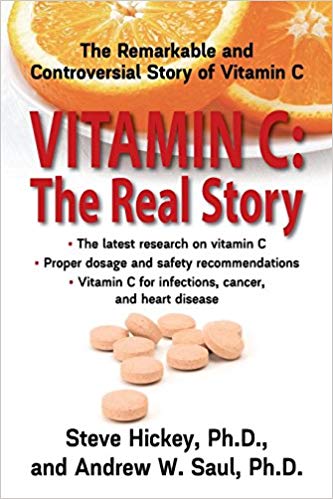


|
Vitamin C: The |
|
"Two writers with an expertise in orthomolecular medicine have created the best book so far with current vitamin C knowledge. It is easily understood by the
interested layperson, and will give new knowledge to the specialist as well. The text is exciting and a challenge to mainstream vitamin views. It
may affect your thinking about what this vitamin could do for you."
The following review is from the Townsend Letter, June 2009 http://www.townsendletter.com/June2009/bc_vitc0609.htm
: The Case for Ascorbate: Vitamin C: The Real Story by Steve Hickey, PhD, and Andrew W. Saul, PhD Basic Health Publications/Turner,
www.basichealthpub.com Reviewed by Adrianne Harun As detailed by authors
Steve Hickey, PhD, and Andrew Saul, PhD, the
medical history of vitamin C reads like a laundry list of missed
opportunities and willful ignorance. Ever since Albert
Szent-Györgyi, MD, PhD, first isolated ascorbic acid and identified it as
"vitamin" C in the late 1920s, controversy has ensued. By
definition, a vitamin is categorized as a micronutrient, an essential element
that human bodies need in small quantities. But Szent-Györgyi made his
classification before the sweeping notion that all vitamins are
micronutrients took hold, and his evolving suspicion that ascorbic acid is
needed in much larger doses has been shared and strengthened by many other
noteworthy scientists who followed, as Hickey and Saul so ably illustrate. Here is Irving Stone, PhD,
who determined that ascorbic acid was not "a vitamin at all, but an
essential dietary factor" and first proposed that high doses be given at
short intervals. And Frederick Klenner, MD, known for his remarkable use of
treating polio successfully with megadoses of vitamin C during a 1948
epidemic. Lendon Smith, MD, risked his reputation when he prescribed
megavitamins, including vitamin C, for children in his groundbreaking 1979
book Feed Your Kids Right. At the forefront, of
course, was two-time Nobel winner Linus Pauling, PhD, whose popularization of
the need for high-dose vitamin therapy opened the door to nutritional therapy
and lifesaving "orthomolecular medicine." The list of acclaimed
scientists and physicians who have championed the role of vitamin C in
fighting disease is long – and includes famed orthomolecular pioneer
Abram Hoffer, MD, PhD, who provides a foreword for the book – and yet,
despite the gains and conclusions reached by these august researchers, the use of vitamin C remains continually
fraught with contentious resistance from the medical establishment, which
can’t quite let go of the "micronutrient" definition. So, in Vitamin C: The Real Story, the authors revisit the definition of
vitamin C. They make the case that vitamin
C is not a micronutrient needed in trace amounts administered once a day to stave
off diet-induced deficiencies. Instead, they argue, it is a vital nutrient
that cannot be assimilated from even the best diet in the significantly large
amounts needed. When the quantity of vitamin C consumed is too low, the
result is illness. Scurvy is perhaps the best-known resultant disease, but
the authors argue throughout this book that "almost every chronic
disease has been related to an insufficient intake of vitamin C." The real meat of this book
lies in Chapter 3, "Taking Vitamin C." Here the authors address the central debate regarding vitamin C usage: the
optimal intake. They look at how and why the Recommended Dietary
Allowance (RDA) – also referred to here as the "ridiculous dietary
allowance" – was wrongly determined, setting up a seemingly
endless battle between those who believe that once an RDA is established,
it’s a "proven," irrevocable fact, and those who have
witnessed the extraordinary results effected by much higher doses. Most
instructively, the authors make their
case by explaining the ins and outs of vitamin C absorption (demonstrating
the need not just for high doses but also divided dosages), detailing the
forms of vitamin C, and debunking warnings about potential side effects. Authors Hickey and Saul do
not shy away from controversy. They discuss the limitations created when
social medicine models are used to provide "proof" that ignores or
flies in the face of the "basic sciences of biophysics, biochemistry,
and physiology." They take the medical community to task for its reluctance
to look beyond poorly engineered clinical trials that are not only useless
but also seemingly purposefully stupid. And they even wade into a burgeoning
dispute, dismissing those who promote a "vitamin C complex" as
preferable to the proven effective and simple ascorbic acid. In clear, concise language,
the authors go on to educate readers on the need for antioxidants, before
taking a closer look at the use of vitamin C therapies as a central, adjunct,
or preventative treatment for infectious diseases, heart disease, and cancer.
Overall, Vitamin C: The Real Story is a timely and valuable clarion call
that cuts through misleading blather and making a strong case for the
orthomolecular use of vitamin C. (Reprinted with permission
of the Townsend Letter http://www.townsendletter.com/ Boldface emphasis added.) Although it is not offered for sale at this website, Vitamin C: The Real Story is available from any internet bookseller.
The next review is from the Journal of Orthomolecular Medicine 2009, 24:1, p 52-54 http://orthomolecular.org/library/jom/2009/pdf/2009-v24n01-p050.pdf Vitamin C The Real Story: The Remarkable and Controversial Story of Vitamin C
A curious title! Thousands of children take Flintstone multivitamins every day; don’t they get enough vitamin C? Many adults take some C when they have a cold and, even without supplements, don’t most people eat enough vitamins and minerals in their fruits and veggies? What could be remarkable or controversial about vitamin C? Authors Hickey and Saul think we need to know the truth about vitamin C. Their fascinating book presents some truly remarkable discoveries, introduces us to vitamin C’s multiple health-maintaining functions and outlines its health-restoring capabilities, while warning us about vitamin C myths. Steve Hickey, PhD and Andrew Saul, PhD present the facts clearly and carefully. Readers will gradually realize that the vitamin C story has two dimensions. On the bright side, for decades, scientific and medical researchers have documented vitamin research, clinical progress and success. Books and medical journals explain that vital amines, as nutritional substances, are essential for health and healing. Over the past 100 years, a succession of scientific researchers studied the biochemistry of vitamin C and learned that vital amines help to maintain normal metabolism. They determined that minimal doses of vitamin C can heal scurvy and sustain life. During decades of follow-up research, scientists discovered that optimum doses of vitamin C have remarkable health-restoring capabilities. Researchers conducted clinical trials, detailed patient recoveries, corroborated findings and wrote journal articles and reference books. However, the vitamin C story also has a disturbing, dark side. Even though decades of research found vitamins safe and effective, millions of patients suffer and deteriorate while professional skeptics devalue the care provided by orthomolecular doctors (who complement standard treatments with therapeutic doses of vitamins). Rather than telling us the facts, certain health professionals dismiss the vitamin C research, ignore the progress reports, minimize vitamin C’s health-maintaining functions and disparage health-restoring claims linked to vitamin C. These skeptics use factoids to support their denials, also outlined in this book. Skeptics cannot rewrite medical history or hide the truth about vitamins. In the early 1900s, biochemists, physicians and researchers discovered that certain nutrients are essential for life. Test rats did not grow or develop unless their diets included vital amines (as vitamins were first described). Medical scientists determined that tiny quantities of vitamins are also necessary for human health. Theyl inked four diseases to vitamin deficiencies: beriberi to B1, pellagra to B3, scurvy to C and rickets to D. The history of medicine records the involvement of Chistiaan Eijkman, Gerrit Grijs, Sir Frederick Hopkins and Casimir Funk. Dr. Eijkmaan and Dr. Hopkins received Nobel prizes for discovering that vitamins are essential for human health. Researchers then searched for the chemical identities of the essential nutrients. Dr. Szent-Gyorgi received a Nobel prize for discovering that vitamin C was ascorbic acid. After discovering vitamins, clinical researchers wondered if essential nutrients might have clinical applications. If so, they needed clinical trials to determine the optimum doses. Scientific and medical professionals mapped the biochemical pathways and determined which metabolic processes required vitamins as co-factors. They quickly realized that a few milligrams of essential nutrients can sustain health but it took decades to discover that therapeutic doses of vitamins can restore health. Centuries ago mankind faced an epidemic of scurvy. Most people know that thousands of British sailors died during long voyages. In 1795, Dr. James Lind did the first clinical trial and discovered how to heal scurvy. It took many decades before sea captains finally added citrus fruits to ships’ stores. British sailors who stayed healthy were then called limeys. What if cancer patients run low on vitamin C today; might these patients develop scurvy-like symptoms? Can megadoses of vitamin C help cancer patients? “Of course not,” scoffed the skeptics, while orthomolecular doctors researched and discovered that optimum doses of vitamin C can indeed help cancer patients feel better and live longer. Other doctors discovered that therapeutic doses of vitamin C can help patients recover from life-threatening infections such as polio, pneumonia and AIDS, reduce toxic levels of lead and mercury and neutralize toxins injected by the bites of venomous snakes and spiders. Like a Swiss Army knife, vitamin C has multiple capabilities. When we pick up a Swiss-army knife for the first time, we expect to find large and small blades but we may not inspect it carefully. In an emergency, we happily discover that a Swiss Army knife comes with a versatile set of built-in tools: a screwdriver, a tooth pick, a cork screw and a file. After these tiny tools save lives, the word steadily gets out until the public knows that each Swiss army knife comes with life-saving tools. Consider the metabolic capabilities of vitamins as tools for restoring health. In milligram doses, vitamin C enables essential metabolic pathways to sustain life and heal scurvy. If taken in large enough doses when a patient has cancer, an infection or an overload of toxins, vitamin C can heal and restore health. The general public still does not know that vitamin C has lifesaving capabilities but the real story keeps coming out. Meanwhile, certain experts, who should know better than to publish false information, scoff at vitamin C research, forget its biochemistry, ignore its metabolic functions and refuse to prescribe it. Why don’t scientific and medical experts study the vitamin C research, review the clinical trials, interview recovered patients and learn that therapeutic doses of vitamin C have proved safe and effective enough to restore health and save lives? How can trusting patients know if our doctors understand and apply the healing capabilities of vitamin C or rely on false factoids to withhold restorative care-by-vitamins? Patients and families, caregivers and health professionals have to read the real story to learn the facts for ourselves. Vitamin C: The Real Story reminds us that a hundred years after the discovery of vitamin C, mankind is still researching vitamin biochemistry and developing medical applications. We understand that vital amines, trace minerals, amino and fatty acids, hormones and many other nutrients are essential for sustaining life. We are still learning that optimum doses of vitamins can restore health. Orthomolecular health professionals know that vitamin C and other nutritional supplements, if given in the right doses, can help patients recover and live well. They routinely prescribe supplements and adjust the doses to suit each patient’s diagnosis and biochemical individuality. Readers of this book will learn to distinguish the true facts about vitamin C from false factoids. Patients can ask their doctors about vitamin research, optimal doses and patient recoveries. Readers are cautioned to take care with their health. Anyone can read this book to learn the basic facts about vitamin C and then study its clinical applications: therapeutic doses of vitamin C can restore health when taken as recommended by qualified medical professionals who understand its biochemistry and know when to prescribe vitamin C as a complementary and restorative treatment. (Review by Robert Sealey, the author of Finding Care for Depression, Mental Episodes & Brain Disorders: 90-Day Plan for Finding Quality Care www.searpubl.ca)
A Short Vitamin C Reading List
A reader says: Virtually
everything you've been told about vitamin C is wrong. An entire
book about vitamin C? Is there really that much more to say about this
subject? As it turns out, there is a great deal more to be said, and Drs.
Hickey and Saul say it very well. In this very well-written, well-referenced
book, we learn specifically how this essential nutrient works in our bodies
to help create and maintain optimum health. We are taken on a journey into
the world of our cells, into the world of free radicals and antioxidants, and
shown with great clarity, the truly remarkable role that vitamin C plays in
the healthy maintenance of our bodies. We learn
also, of the history of vitamin C research, and why the mainsteam medical
community has chosen to ignore this research. Most importantly, we learn
specifically how we can best benefit from the many decades of research on
vitamin C, in order to gain and maintain good health in our own lives. For anyone
confused by the seemingly conflicting information printed in the mainstream
press about vitamin C, I highly recommend this detailed, yet highly readable
book. Reading VITAMIN C: THE REAL STORY, will likely change the way you think
about vitamin C. Then again, it just may change your life. (Richard
Bennett, Although it is not offered for sale at this website, Vitamin C: The Real Story is available from any internet bookseller. Andrew Saul is also the author of the books FIRE YOUR
DOCTOR! How to be Independently Healthy (reviews at http://www.doctoryourself.com/review.html
) and DOCTOR YOURSELF: Natural Healing that Works. (reviewed at http://www.doctoryourself.com/saulbooks.html
)
|
|
|
AN IMPORTANT NOTE: This page is not in any way offered as prescription, diagnosis nor treatment for any disease, illness, infirmity or physical condition. Any form of self-treatment or alternative health program necessarily must involve an individual's acceptance of some risk, and no one should assume otherwise. Persons needing medical care should obtain it from a physician. Consult your doctor before making any health decision. Neither the author nor the webmaster has authorized the use of their names or the use of any material contained within in connection with the sale, promotion or advertising of any product or apparatus. Single-copy reproduction for individual, non-commercial use is permitted providing no alterations of content are made, and credit is given. |
|
|
|
|
| Home | Order my Books | About the Author | Contact Us | Webmaster | |
